
Burns Building
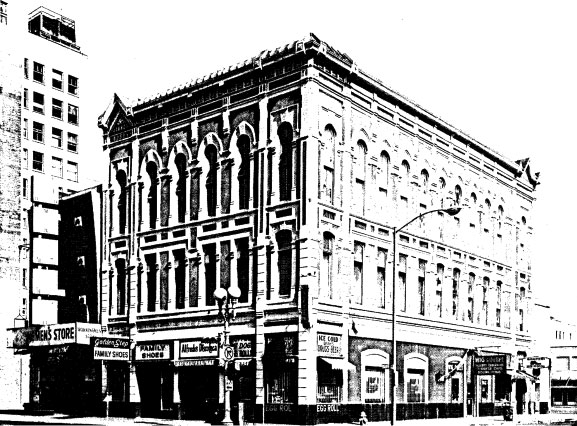
421 Main Street
1883
Edward J. Duhamel, architect
Demolished
The information in this entry is taken directly from the 1980 Houston Architectural Survey and has not been significantly revised or updated.
Classification
building; commercial; privately owned; occupied; restricted access
Description
The Burns Building is a three-story Victorian Italianate-style commercial building erected in 1883 on the northeast corner of Main Street and Prairie Avenue. The structure is rectangular (59′ x 100′) with a small one-and-one-half-story addition in the rear. Of brick construction, the two main facades are stuccoed and heavily decorated with overlaid plasterwork. Although several obvious alterations have been made during this century (most notably removal of both the first-floor iron canopy and a pavilion over the southeast corner of the building), the facade of the upper floors remains virtually intact.
The narrower Main Street facade originally had an iron canopy extending all the way across the street front. Supported by thin columns and decorated with cast iron acroteria, this feature obscured the first-floor facade in early photographs and was removed sometime in the first half of this century. Today the first floor is protected at the street level by a black marble base course about three feet high which was added in a 1965 renovation. A large square plate glass window in each corner bay is reflective of an original aperture, but modernized and protected with burglar bars. The old framing is not in evidence. These windows are flanked by original piers, grooved to look like stone.
Entrances next to the corner windows lead to corner shops and a wider central entry leads to the main first-floor space. This door originally opened to a very wide hallway, with commercial spaces on each side. The ABCBA scheme probably replaces an AABAA scheme. Above the lettered (with shop names) transoms over each aperture, two separate string courses articulate a flat stuccoed surface from which iron decoration and the canopy once extended. The piers, which rise to the main cornice of the building, are laid over horizontal molding strips giving the vertical axis visual dominance in the end bays.
The second-level Main Street facade reads ABBA. Two wide central bays each contain two windows paired only because the lintel and hood molding are contiguous for each pair. The matching narrow end bays each contain thin rectangular windows with two fixed glass panels (a square over a vertical rectangle). Stonelike plaster surrounds frame each window. A square hood, from which extends a decorated keystone, ornaments the stilted segmentally arched window. Slim panels of blue-painted stucco fill in each bay. A horizontal panel above the hood molding contains diamond-shaped decorations. Originally all six windows on this elevation were identical, like the two left in the end bays. The window framing has been altered and the keystones and decorative plaster have been removed, taking away the segmental arch, leaving a rectangular effect. Although not true to the original, this 1965 work was done convincingly and the building at this level does not appear disjointed.
The third-level Main Street facade (ABBA) has its corner bays defined by the vertical piers which ascend from the ground level. All the windows, even more elongated than those of the second floor, have a round arch in the top of the original 2/2 double sash windows. Window framing is similar to the floor below, except the hood molding has a pointed arch with overlaid keystone. Three brackets between the central bays support a belt course which wraps around the building. The main cornice which rests above more overlay and etched ornament extends across the front and around through the first bay on Prairie Avenue.
In the first bay on Main the cornice is interrupted with a pediment which frames a fleur-de-lis like medallion above the date “1883”. “Burns” appears in a stucco panel which is repeated without ornament or inscription between the main cornice and belt course. Originally a pavilion roof, one bay in length and width, rested on the southwest corner of the building. Topped with iron cresting, this four-sided pyramidal element contained small pedimented openings in the center of a parabolic arch on each side.
The Prairie Avenue facade, eleven narrow bays, is very similar to the Main Street facade. The corner bays match those on Main, except in the last bay where an entrance, still surrounded by its original framing, gives access to the second and third floors. Otherwise the street level, as on Main Street, is filled with signs, eye-catching plastic fringe, burglar bars and some striped awnings which obscure those architectural features remaining.
There is some irregularity in the second floor window treatment, but it basically conforms to the Main Street pattern of decoration. The third floor contains nine round-arched windows in the center bays with pointed-arched window moldings without keystones. The elaborate cornice is replaced after the first bay with simpler, unornamented moldings which define the roofline. The same pediment appears, without inscription, over the final bay of this elevation.
A small windowless painted stucco addition is tied to the original building with the black marble base course. A small doorway leads in from Prairie.
The building was restored in 1965, but is again in need of paint and repair. No part of the original interior decoration remains. During this renovation a Victorian-era motif was employed inside. The wide mall running through the building was decorated with New Orleans-type ironwork and chandeliers.
Area of significance
architecture
Significance
The Burns Building is a good example in Houston of the High Victorian style of architecture as applied to commercial buildings. It is the only known building of the architect Edward J. Duhamel still standing in Houston. The building’s important corner site gives it more visibility than other nearby buildings and its relatively small scale makes it a pleasant diversion from Houston’s downtown skyscrapers in 1980. Historically the building held, for approximately 25 years, two of the city’s oldest and most respected jewelers, as well as the meeting hall on its third floor of one of Houston’s first fraternal orders. Renovation in 1965 altered the building more on the interior than exterior. Although the building is today two-thirds vacant, the Burns building is well maintained.
Hugh Burns, a railroad contractor from San Antonio, erected the Burns building as a business venture in 1883. The site was located on a busy corner near the financial center of Houston on a block full of physicians’ offices over various kinds of shops. Originally the Burns building was number 77 Main but in 1891, when the centenary numbering system was adopted, the address became 415-419 Main (and later 417-421). The building originally cost $20,000 to construct.
Although the building was at one time attributed to George E. Dickey and J. Arthur Tempest, research has shown that Edward J. Duhamel (whose work the Burns building more closely resembles) was the architect. The major body of Duhamel’s work was in Galveston where he practiced before and after his brief residence in Houston. In 1878 he won the competition for a new City Hall and Market (burned in 1902) and moved to Houston to complete that project. While there he received in 1883 another important commission, to design the county courthouse (demolished 1907). After completion of the Burns building and the courthouse, Duhamel returned to Galveston in 1884. Among his other accomplishments Duhamel was appointed supervising architect for the Texas State Capitol in 1888, replacing Jasper N. Preston, who left Texas to go to Los Angeles. There are no other known Duhamel buildings extant in Houston.
The original program for the Burns Building called for first-floor commercial space, second-floor office space and the third floor, with fewer partitions, higher ceilings and grander windows, suitable for club meetings. The Knights of Pythias reserved this third-floor space for their lodge meetings. Founded in 1872, this chapter became Lamar Lodge No. 189 in 1893. “Castle Hall,” as they called it, continued to be their headquarters until 1918 when they moved to Fannin Street. It appears that no regular tenants occupied the third story after that time. Original tenants of the first floor were R.W. McLin & Company, retail dealers in dry goods, whose manager W.T. Tuffly, a well-known merchant, was also president of the Knights of Pythias. The second floor offices were, in this early period, occupied by several doctors, none of whom remained long.
McLin died in 1886 and for almost ten years thereafter, A. Hampe Dry Goods, “Dealer in Staple & Fancy,” occupied the ground floor of the Burns building. Several unsuccessful dry goods stores had this space after 1895 until Lechenger’s Jewelry moved in during 1901 to remain until 1926. Another prominent jewelry business, Sweeney’s, moved into the other half of the downstairs in 1905 and remained two years longer than Lechenger’s. In 1906 Houston architect Olle J. Lorehn added a small workshop to the rear of the building on the Prairie Avenue side for J.J. Sweeney Jewelry. In 1928 Mosk Clothiers took over the second floor of the building and various shops occupied the ground floor for the next year. By 1935 Burt’s Shoes had moved into the ground floor. These relatively long-term tenants shared the building with several other shops. In 1965 the building was purchased from the estate of Mary Burns, wife of Hugh Burns, by the American Savings and Loan Association. Harold Calhoun of the architectural firm of Wirtz, Calhoun, Tungate and Jackson supervised the 1965 exterior restoration, which cost $50,000. A branch of American Savings occupied the building until 1971. Since that time the facades have been sandblasted and painted and the wood- and metalwork cleaned. Today the upper floors are vacant and the ground floor is occupied by Golden Step Family Shoes, Alfredo’s Discoteca, First Corner Snack Market, Wigs Outlet and Samperi Shoe Hospital.
Bibliography
Periodicals
Houston Chronicle. 31 October 1965.
Houston City Directory. Various years, 1881-1978.
Houston Daily Post. 31 August 1883.
San Antonio City Directory. 1908.
Books
The Art Work of Houston, 1894. Chicago: W.H. Parish Publishing Company, 1894.
Other
“Views of Houston.” Photographs by George Beach, 1915. Houston Metropolitan Research Center, Houston Public Library.
Conversation with Mrs. Ann Quin Wilson.
Map
Share with friends!


