
House for Mr. and Mrs. Harry C. Weiss
2 Sunset Boulevard
1919-1920
William Ward Watkin, architect
The information in this entry is taken directly from the 1980 Houston Architectural Survey and has not been significantly revised or updated.
Classification
building; privately owned; occupied; restricted access; residence
Description
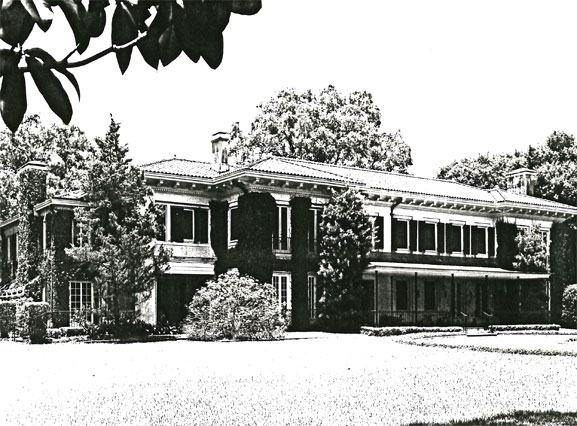
The residence for Mr. and Mrs. Harry C. Wiess, an Italian villa, was built in the Houston subdivision of Shadyside at the intersection of South Main Street and Sunset Road opposite the principal entrance to the campus of the Rice Institute (now Rice University). The Wiess house was designed to harmonize with the original buildings on the Rice campus.
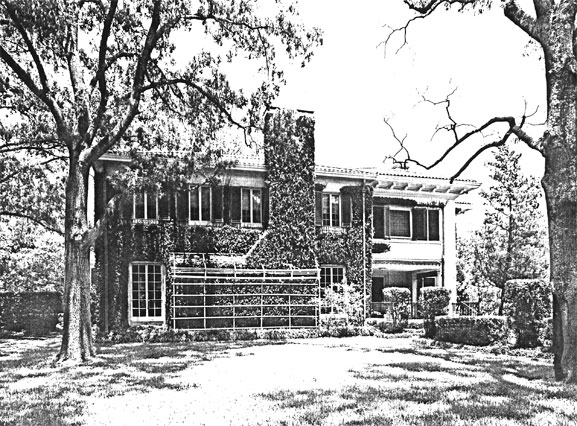
The Wiess house originally took shape as an extended H in plan. The main elevations face east (toward South Main Street) and west. Subsequent additions in both the southwest and northwest corners of the house have altered its initial configuration. The house is two stories high throughout. The west elevation consists of a central range framed by two projecting bays, which are in turn flanked by short, recessed and wings of unequal depth. The central range contains four equally dimensioned bays and, at its south end, a fifth, somewhat expanded, bay containing the entrance. The framing elements are each two bays in extent and the end elements (originally containing ground floor loggias and sleeping porches above) are also two bays wide. On the west elevation, the inset central range is only three bays wide, because it acquires an additional off-center, projecting gabled bay, containing the garden entrance. Long wings of unequal length extend westward from either side of this elevation to frame the central range. The house’s long north elevation contains two projecting bays, one of two stories (the loggia and sleeping porch), the other one story (containing the kitchen). Visible toward the west end of the wing is a sectional change, which results in a lower second floor. The south elevation (facing Sunset Road) comprises the five bay living room wing, attached to the projecting loggia and sleeping porch bay on the east. As on the north facing serving wing, the eaves line of this wing is lower than on the main body of the house, since the first floor is not set as high above grade.
The Wiess house is constructed of tile block bearing walls, surfaced with rough cast plaster, above a reinforced concrete basement and foundations. The house is covered by a series of hipped roofs clad with red and purple clay pantiles.
Several porches and loggias occur on the Wiess house. The principal one comprises a large, brick paved raised terrace inserted between the projecting bays before the central range of the east elevation. Originally open, the terrace was covered in the 1926 remodeling by a copper canopy supported on six equally spaced iron columns. Delicate iron work balustrades run between the columns, turning down to frame steps descending from the central bay. A loggia is cut into the house in the southeast corner end block. An open terrace extends southward from this loggia past the living room. It is also framed by an iron balustrade.
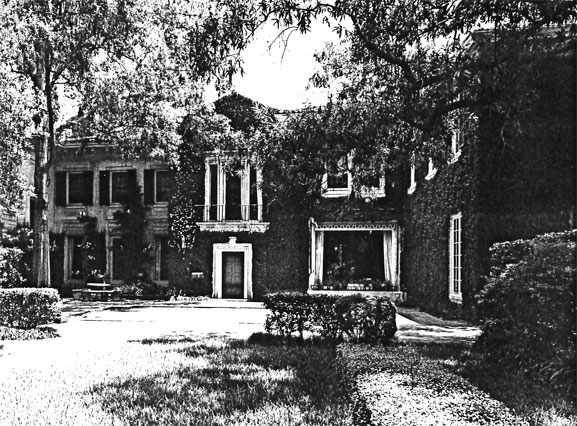
The main entrance was originally in the projecting gabled bay on the west elevation of the house. Opposite, on the east elevation, a portal framed by columns bearing a stone balcony opened onto the garden terrace. In the 1926 remodeling, the roles of these two entranceways were reversed. On the west gable, bands of molding frame a low door. These form an architrave above the door, keyed with a projecting console. Surmounting the door is a high, triple light stair window, also framed by a molded stone surround. The columns and balcony were removed from the original garden door in the 1926 remodeling and a new doorway, set in a stone lined recess, was installed.
On the east elevation, two window types occur: 6/6, double hung, wood sash windows and wood sash French doors. French doors appear on the first and second floors in the two projected bays and in two of the five ground floor openings in the central range. Above the entry portal, two double hung windows are paired to compensate for the wider bay spacing. On the main body of the house, the first and second floor openings are grouped in vertical channels, with sunk panels below the second story windows and raised molded panels and molded architraves above the ground floor openings. The addition of the terrace canopy and the shuttering of second story windows above obscured this arrangement on the east elevation, but it remains visible on the projecting bays, on the inset segment of the west elevation and on the original portion of the north service wing.
The west elevation repeats, in the inset three bay range, the fenestration pattern of the inset east elevation, except that the ground floor French doors have been replaced by large, single pane, glazed openings. The projecting bay flanking the gabled entrance bay also contains a reglazed aperture; formerly a triple light opening, it is now a single glazed expanse. Sheet glazing has also been introduced in the triple light stair window. Three dormers are evenly spaced across the main roof segment on the west elevations. The living room wing contains French doors in the ground floor openings and casement windows in the second floor openings. These windows obtain no special surrounds, only smooth surfaced, projected stucco sills. The north wing contains square headed, double hung windows.
The roofs, as noted, are hipped and clad with tile. On the original portion of the house, a high frieze zone terminates in a denticulated band. Above this band, prominently articulated consoles support the overhanging eaves, which are faced with a broad cornice molding. The gabled west bay has a tile coping. On the living room wing and the service wing addition, the depth of the frieze zone is much shorter. Denticulations and consoles are deleted; there are slender stacks with oversailing bands near their summits and stout bases where they penetrate the roof surface. The chimneys on the dining room (north elevation) and living room (south elevation) were built in the 1926 remodeling. Both are more massively profiled than the original stacks and both project from the wall surface. The living room chimney is curiously massed, for it is set on a long, projected ground floor level housing enclosed by trellis work. The stack rises from one side of this housing, rather than from the center, because of the location of the second floor hearth. The chimney on the west end of the north wing imitates in configuration the examples of the 1926 chimneys.
The floor plan of the Wiess house provides for the distribution of large interior spaces along a lateral north-south corridor. A wide, axial reception hall spans between the east and west entries, with a cantilevered spiral stair rising in a semicircular niche above the west elevation. The living room, one-and-one-half feet below the level of the other ground floor rooms, occupies the entire south wing. Filling out the south projecting bay are a foyer on the west (into which the lateral corridor dies) and a library on the east. Beyond the library, the reception hall occurs, then a cloak room followed by a large dining room, filling two bays of the central range and the north projecting bay. A ground floor loggia opens from the library, foyer and living room. A breakfast room opens off the dining room in what was originally the north end loggia. The north wing contains secondary stairs, kitchen and pantry spaces, a single garage stall and two storerooms.
On the second floor, another lateral corridor provides circulation across the west side of the house. The master bedroom and bathrooms are situated above the living room. Four bedrooms and three bathrooms are spaced out behind the east elevation. A guest bedroom, a maid’s bedroom and a housekeeping room occupy the north wing.
The most notable interior spaces are the stair hall, the library, the dining room and the breakfast room. Built of oak and birch, the cantilevered stair has an iron balustrade. The living room is a great rectangular space with exposure on four sides. Its decoration is simple: a plaster surfaced wall, with built up plaster cornice, chair rail and window surrounds. The marble mantle is antique. The library is paneled in polished English oak. Bead molding surrounds the bookshelf windows and door openings. The door is crowned by a broken pediment. The immense dining room is sheathed in apple green paneling with bead molding in the cornice and in the door and window surrounds. A pediment surmounts the main doorway. On the east wall, the two northernmost sets of French doors are set into deep, paneled reveals, within which cabinets and radiator enclosures are secreted. The breakfast room is enclosed by a plaster “tent” ceiling. Its walls are covered with Chinese scenic wall paper. Door and window surrounds are of bamboo.
Apart from the house, the two-acre site contains a four car garage with servants’ quarters above in the northwest corner of the lot. Like the main house, this is of hollow tile construction, plastered and covered by a red tile roof. Next to it is a tool shed and two bay greenhouse. Formal gardens extend beyond the house on the west and south. Set between the advancing wings on the west elevation is a flagstone terrace containing a rectangular reflecting pool. Beyond this stretches an axially aligned garden, demarked by four parallel rows of planting beds with grass runways in between. A raised grass terrace defined by a hedged crescent terminates the vista. The south garden, also axially planned, opens off the loggia and terrace on the southeast corner of the house. The driveway enters the property from South Main Street and proceeds westward along the north property line to the garage and service area. An oval turnaround, connected to the drive, occurs before the east covered terrace. The street frontages of the Wiess property are enclosed by a seven-foot high stucco surfaced, tile block wall.
The Wiess house was designed in 1920 and constructed the same year. A one-story addition containing a new kitchen was designed and constructed in 1923. The south wing, the redirection of the entrances, an extensive remodeling of the ground floor and the new drive were designed and built between 1925 and 1927. The library was remodeled in 1928. The garage was extended and an adjacent tool shed and greenhouse was built in 1928-1929. Between 1934 and 1936, the service wing was extended, the northeast end block was remodeled, a central air conditioning system was installed and the street wall was built. The west garden was laid out at the same time.
William Ward Watkin designed the original house. A general construction contract for $68,000 was awarded in early March 1920 to Horton and Horton. Watkin was also responsible for the 1923 kitchen addition and service wing remodeling. The alterations and additions of 1925-1927 were the work of the architect Harrie T. Lindeberg, who also remodeled the library in 1928.
Christain J. Miller was general contractor for this work. The garage addition, the greenhouse and the alterations and additions of 1934-1936 were carried out by the architect John F. Staub. Ruth London was the landscape architect responsible for the garden design. ^
The Wiess house is in good condition. It is owned by Rice University and is leased to its present occupant. Deed restrictions in the Shadyside subdivision mandate that it be used only as a single-family residence.
Area of significance
architecture
Significance
The house for Mr. and Mrs. Harry C. Wiess is important as one of the Houston works of Harrie T. Lindeberg, a nationally known American architect of the early twentieth century. Lindeberg was not the original architect however. Rather, he added to and altered an existing house, designed by the Houston architect William Ward Watkin. The house was subsequently added to by a third architect of some prominence, John F. Staub. Located in the residential subdivision of Shadyside, the Wiess house was conceived as an exemplary architectural gesture. For Watkin treated it with Italianate-Mediterranean detail to insinuate an urbanistic relationship with the architecture of the adjacent Rice Institute. As such, the house played a role in the evolution of the area around Hermann Park and the Rice campus into a distinctive civic district during the 1910s and 1920s.
Olga Keith and Harry Carothers Wiess were both members of prominent Beaumont families. They moved to Houston in 1919, 10 years after their marriage, because of Harry Wiess’s position as co-founder, director and vice-president of Humble Oil and Refining Company, which maintained its headquarters in Houston. A civil engineer by profession, Wiess had been charged with the responsibility of constructing Humble’s major refinery, at Baytown, in 1919. The couple decided it was easier to move to Houston than for Wiess to have to commute from Beaumont.
In November 1919, Wiess purchased the two acre Lot A in the newly opened subdivision of Shadyside, lying on the outskirts of Houston next to the Rice Institute campus and across South Main Street from Hermann Park. Developed between 1916 and 1919 by Joseph Stephen Cullinan, an independent oil operator who founded the Texas Company, Shadyside was laid out by the St. Louis landscape architect George E. Kessler, who also planned Hermann Park and the parkway segment of South Main Street bordering the park and the Rice campus. Cullinan sold lots primarily to friends and business associates. Among these were two Houston oilmen, Robert Lee Blaffer and William Stamps Farish, who were also co-founders of the Humble Oil and Refining Company. Blaffer prevailed upon Wiess to acquire a house site in Shadyside and he prevailed upon Wiess to acquire a house site in Shadyside and he prevailed upon Cullinan to sell to Wiess. A number of other lot owners in Shadyside were men with oil related interests who had also come to Houston from Beaumont.
To design their house, Mr. and Mrs. Wiess retained William Ward Watkin. Watkin had come to Houston in 1910 to supervise construction of the original Rice buildings for the Boston architects Cram, Goodhue and Ferguson. When the new university opened in 1912, he was appointed to the faculty to teach architecture. He continued to represent the Cram office in Houston, but also commenced independent practice. Watkin had just completed houses in Beaumont for Wiess’s half-brother and half-sister, Perry Wiess and Nena Wiess Priddle.
Watkin designed the Wiess house to resemble certain aspects of the Rice campus buildings, especially the units of the Residential Group, which had rough cast plaster walls and red tile roofs. Another Rice precedent suggests itself in the instance of the Wiess house, for its first floor plan markedly resembles the parti of Cram and Ferguson’s projected (but never realized) President’s House of 1916-1917 for the Rice Institute. The Wiess house was smaller, but the use of a lateral corridor, off of which major rooms opened, intersected by a longitudinal entrance corridor, with the main stairs occurring at this intersection, appears in both plans. The Wiess house manifests a number of details characteristic of Watkin’s work. It is set on a grass berm (presumably to protect it from standing water), its massing displays a rather labored asymmetry and its composition is marked by vertical attenuation. Like several other early houses in Shadyside, the main entrance faced the rear of the lot (west), so that the east elevation (facing South Main Street) might have unrestricted access to the prevailing breeze and an unimpeded view toward Hermann Park.
A one-story kitchen was added to the north elevation of the service wing, on what was then the northwest corner of the house, in 1923. This was designed by Watkin, who at an unspecified date, also produced a scheme for a swimming pool and bathhouse, which was not realized. Neither were the preliminary studies he undertook for adding a new living room onto what was the southwest corner of the house, alongside the library and the loggia. For in 1925, Mr. and Mrs. Wiess turned to another architect to carry out this project, Harrie T. Lindeberg of New York.
Lindeberg was one of the leaders of the eclectic tendency, which came to dominate American architectural practice in the years immediately before World War I. His reputation proceeded from the country houses, which he had designed in the suburbs of New York, Boston, Chicago, and Cleveland. In 1919, Hugo V. Neuhaus, a Houston stockbroker, asked Lindeberg to design his family’s house, which was built in Lot I in Shadyside between 1920 and 1923. Through Neuhaus’s intercession, Lindeberg procured commissions for two (eventually three) more houses in Shadyside. Lindeberg even sent his young associate, John F. Staub, from New York to supervise construction of these houses, the last of which had just been completed when the Wieses commissioned the alterations and additions to their house.
Lindeberg added the south wing onto the southwest corner of the house. This contained a grandly scaled living room with a master bedroom suite above. He left the library (in the projecting south bay of the east elevation) intact. But he changed entry patterns by bringing auto traffic up to what had been the garden terrace, which was covered with a copper canopy. The former front door (on the west) became the garden door. Lindeberg demolished Watkin’s complicated entry sequence and stair, replacing them with a low door, a high stair window and a simply, beautifully proportioned and detailed spiral stair. Half of what had been the living room (set behind the central range on the east elevation) was turned into a capacious cloakroom. The other half was combined with the existing dining room to produce a much enlarged space. Because the old dining room occupied the northern projecting bay on the east elevation, Lindeberg had to furr out the east wall of the dining room, setting the northernmost French doors in deep reveals, so that the space would have no interior jog. To effect this alteration, Lindeberg had to insert a steel beam to carry a load bearing second story wall across the dining room, replumb a second floor bathroom and demolish an internal chimneystack.
The exterior of Lindeberg’s additional wing blended unobtrusively with Watkin’s house, except that the eaves line of the roof was lower, as Lindeberg sought a more balanced and less aggressively vertical proportion. He played some rather complicated tricks with the venting of fireplaces (and with the alignment of first and second story windows) on the south elevation to provide symmetrically placed hearths in both the first floor living room and second floor bedroom. In 1928, Mr. and Mrs. Wiess retained Lindeberg to panel the library, bringing it up to the standard of the rest of the major rooms. John F. Staub, who remained in Houston to begin an independent practice, added onto the garage in 1928-1929 and next to it built a storage shed and greenhouse. The next year, Mr. and Mrs. Wiess had Staub design a weekend retreat for their family, The Stables, located west of Memorial Park. They subsequently returned to him in 1934 for a new round of alterations and additions to the Shadyside house.
Between 1934 and 1936, Staub extended the service wing, remodeled several existing rooms, installed a central air conditioning system (one of the early residential installations in Houston) and designed a wall to enclose the property along South Main Street and Sunset Road. Staub’s service wing extension, two stories high, matched the treatment, which Lindeberg had given his additional wing, so that it was lower and less vertical than the Watkin original. The interior remodeling resulted in the transformation of the north loggia, opening off the northwest corner of the dining room, into a tented breakfast room. The Houston landscape architect Ruth London simultaneously laid out a simple, axially planned garden, stretching from the garden door westward to the rear property line.
Mr. and Mrs. Wiess made their house a social center in Houston, prepared as they were to entertain at a large scale, both indoors and out. From 1937 until his death in 1948, Harry Wiess was president of the Humble Oil and Refining Company. He was a charter trustee of his alma mater, Princeton University, a member of the Corporation of the Massachusetts Institute of Technology and a trustee of the Rice Institute. Wiess was also a builder. In addition to Humble’s Baytown Refinery, he was responsible for the parish, house of Palmer Memorial Church (1930, by Staub), the Humble Tower in downtown Houston (1936, by Staub and others), Rice Stadium (1938, by Watkin) and the Fondren Library (1949, by Staub) at the Rice Institute. He is memorialized in Wiess College and the Keith-Wiess Geological Laboratories at Rice, at the Wiess Memorial Chapel in the Texas Medical Center and in Keith-Wiess park.
Olga Keith Wiess continued to dwell in her Shadyside house for 25 years following her husband’s death. In 1974, five years before her death, she gave the house to Rice University for use as a president’s house, a neat irony considering the derivation of William Ward Watkin’s parti. However, the president of the university chose not to live there. Currently, the house is leased by the university.
Bibliography
Periodicals
The Houston Gargoyle. 19 January 1930. Vol. 3, p. 17. Dorothy Hoskins and Calvin Wheat, “Grace, Beauty in the Southern Home of Mr. and Mrs. Harry Carothers Wiess, Shadyside.”
Houston Post. 9 March 1920. “Eight Permits Issued by Building Inspector.”
Texas General Contractors Association Monthly Bulletin. March 1926. Vol. 7, p. 17.
Books
The Architecture of John F. Staub, Houston and the South. Howard Barnstone. Austin: University of Texas Press, 1979.
Domestic Architecture by H. T. Lindeberg. New York: William Helburn, Inc., 1940.
History of Humble Oil & Refining Company: A Study in Industrial Growth. Henrietta M. Larson and Kenneth Wiggins Porter. New York: (Harper Brothers Publishers, 1959.
Houston: An Architectural Guide. Peter C. Papademetriou, editor. Houston: Houston Chapter, American Institute of Architects, 1972.
The New Encyclopedia of Texas. Ellis A. Davis and Edwin H. Grobe, editors. Dallas: Texas Development Bureau, c. 1926, Vol. 1, p. 653.
Who Was Who in America, 1942-1950. Chicago: The A. N. Marquis Company, 1950, Vol. 2, p. 575.
Other
Architectural drawings and specifications for the Harry C. Wiess house (full documentation on the Lindeberg and Staub work, meager documentation of the Watkin work). Woodson Research Center, Fondren Library, Rice University.
Joseph Stephen Cullinan Papers. Houston Metropolitan Research Center, Houston Public Library.
“The Garden Club of America Annual Meeting, Houston, 1939.” Brochure, vertical file “Architecture.” Texas and Local History Department, Houston Public Library.
Schleuter/Bank of the Southwest Collection, “Houses—Identified” File. Texas and Local History Department, Houston Public Library.
“The Work of William Ward Watkin.” Brochure, c. 1924. Fondren Library, Rice University.
Share with friends!


