
Commercial National Bank Building
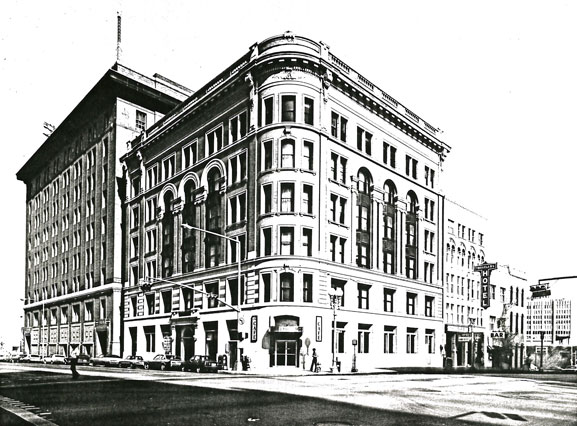
116-120 Main Street
917-919 Franklin Avenue
1904
Green & Svarz, architects
The information in this entry is taken directly from the 1980 Houston Architectural Survey and has not been significantly revised or updated.
Classification
commercial building; original site; good condition; partially occupied; restricted access
Owner
Description
Located on the northwest corner of Main Street and Franklin Avenue, the light-brown brick and limestone-faced Commercial National Bank Building is a six story neo-classical structure. The building is rectangular in plan, 98 feet by 84 feet, with the Franklin Avenue facade one bay longer than the Main Street facade. The curved bay joining the two facades contains the entrance to what was originally the main banking lobby, now occupied by a cafe. The center bay of the Franklin Avenue facade contains the entrance to the elevator lobby serving the offices on floors two through six, which originally contained 24 suites each.
Vertically, the building is organized in three zones: a base, shaft and attic. The base consists of the first two levels. The ground-floor facade was originally rusticated with deeply grooved smooth-cut limestone, which gave way to alternating bands of brick and limestone at the second level. The shaft is composed of levels three through five. The central feature of the street facades of the shaft are three centrally placed contiguous arched apertures upheld by colossal Ionic pilasters. Each aperture contains two tiers of bay windows surmounted by a thermal window. The attic, or sixth level, is separated from the shaft by a belt course and is topped by a limestone cornice and balustrade. An enclosed sixth-level pedestrian bridge connects the Commercial National Bank building to the Southern Pacific building immediately to the west.
Area of significance
architecture
Significance
The Commercial National Bank Building is one of the largest neo-classical commercial buildings remaining in what was the center of Houston’s financial district from the turn of the century through the Great Depression. Its curved corner bay, limestone ornamentation and large-scaled ranges of bay windows make it a dominant element of the lower downtown streetscape. Completed in 1904, it was one of the first steel-frame structures erected in the city.
The Commercial National Bank was designed by the firm of Green and Svarz. Gerhard C. Svarz apparently left Houston in 1904 after this partnership dissolved. Lewis Sterling Green, however, remained in Houston and practiced architecture both alone and in partnership with Joseph Finger and Birdsall Briscoe.
The Commercial National Bank was chartered July 1, 1886, with a capital of $500,000 (one of the largest in Houston at that time). The bank building was constructed under the presidency of W.B. Chew. J.M. Dorrance, who later became vice president of the bank, was on the bank’s Board of Directors. (Interestingly, the only other Green and Svarz building still standing in Houston is the Dorrance building at 114 Main.)
The Commercial National Bank moved into its new quarters at the corner of Franklin and Main on November 19, 1904, and remained there until March 1912 when the bank merged with the South Texas Commercial National Bank and relocated to 213 Main Street. In July 1912, the National Bank of Commerce was organized and occupied the quarters left vacant by the Commercial National Bank. The National Bank of Commerce remained in the building until 1915, at which time Western Union became its principal tenant. Western Union occupied the first three floors until 1970, during which time the building was referred to as the Western Union building.
The office suites in the top five floors of the Commercial National Bank Building were registered at 917-919 Franklin Avenue. They were occupied by oil companies and civil engineers and other similar tenants. William Marsh Rice maintained offices on the third floor. After Rice’s death in 1904, the first offices of the Rice Institute occupied part of the sixth floor. The Institute maintained a suite in the building until 1926, after which Southern Pacific Railroad Company took over the entire sixth floor, which was subsequently connected by a bridge across an alley to the sixth floor of the neighboring Southern Pacific building.
Various restaurants, beauty and barber shops leased parts of the ground floor throughout Western Union’s 55-year tenure. By the early 1970s the building was two-thirds empty. In 1978 the building was extensively renovated.
Bibliography
Periodicals
Houston. April 1940, p. 77-78.
Houston Chronicle. 9 July 1912; 15 July 1952.
Houston City Directory. Various years, 1903-1978.
Houston Post. 3 March 1912; 4 July 1912.
Books
Houston: An Architectural Guide. Peter C. Papademetriou, editor. Houston: Houston Chapter, American Institute of Architects, 1972, p. 26.
Houston as a Setting of the Jewel: The Rice Institute. Julia Cameron Montgomery. Houston: privately printed, 1913, p. 102.
Souvenir Anniversary Edition of the Houston Chronicle. Houston: 1905.
A Thumb-nail History of the City of Houston, Texas. S.O. Young. Houston: Rein & Sons Co., 1912, p. 97.
Share with friends!


