
Kiam Building
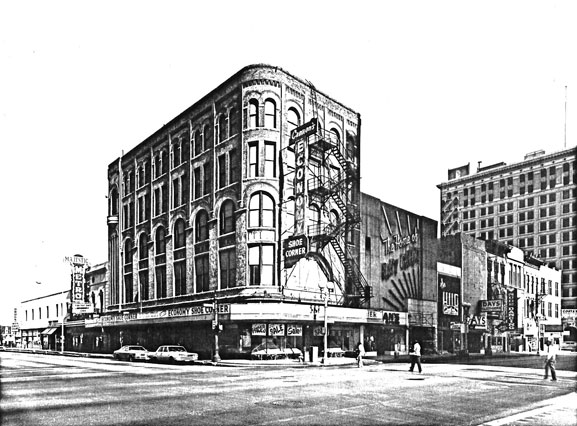
320 Main Street
1893
H.C. Holland, architect
The information in this entry is taken directly from the 1980 Houston Architectural Survey and has not been significantly revised or updated.
Classification
privately owned; commercial building; inaccessible; unoccupied; poor condition
Owner
T.F. Glass, Jr., William L. Bowers, Jr. and Partners
Description
Located on the southwest corner of Main Street and Preston Avenue, the Kiam Building is one of many buildings erected in the 1880s and 1890s in the United States that were influenced by the Romanesque-inspired architecture of H. H. Richardson (1838-1886). These buildings were characterized by the use of Romanesque arches, heavy massing, ribbon bands of deep-set windows and use of rough faced stone or stone-trimmed red brick, as in the Kiam Building. The structure consists of two parts, a five story rectangular section on the corner and a three-story section known as the Kiam Annex extending along Main. Also part of the Kiam complex was another three-story building on Preston (demolished in 1925 for the Ritz Theater building), which although physically contiguous and stylistically similar to the main building, had a compositional scheme that was not consistent with the other two sections. The small building’s main feature was a protruding middle bay, with entrances, which rose to a pavilion roof with one bay on either side. Each of these bays contained two floors of three rectangular, stone-trimmed windows. The third floor on either side of the pavilion roof was capped by a stone cornice.
On Preston, the Kiam Building is seven bays (ABBBBBB) plus a rounded corner bay. In the first bay an arched entrance on the first floor opened to a staircase leading to the upper floor offices. The stairwell is articulated on the exterior by this protruding bay fenestrated with three sets of long narrow windows, arched at the top just above the third story. Between the fourth and fifth stories, a curious stone-trimmed, arched window is punctuated by a stone balconet corbelled out from the wall like a medieval English oriel window support. This asymmetric feature is not repeated in the rest of the building. An unremarkable wood paneled door, “back door” to the first-floor dry goods store, fills the second bay. The five remaining bays on Preston contained rectangular display windows and were separated by brick piers that extended to a double stone belt course wrapping around the building above the first floor. Six paired, rectangular sash windows, framed by stone mullions, rise from a stone spandrel on the second floor. The third floor band of windows, which continue through the corner bay, are round arched and stone-trimmed. Within the frame of these windows is a central double sash window flanked by a narrow window on each side shaped by the arched brick. Stone mullions separate the three sections. Stone panels between the second and third stories and the brick piers which rise between the bays (which are capped by a short stone belt corbel from which thin pilasters ascend to the cornice of the building) give the windows on Preston the appearance of being six double story arched windows.
In the fourth story, each bay contains two tall rectangular windows separated by the red brick facing but joined by a continuous stone sill under each pair. Likewise, the fifth story windows on this side are arched with double eyebrow brickwork over each set. Short brick corbels built up to a heavy stone cornice supported by stone scroll brackets. Brickwork continues above the cornice to provide a roof railing which ends in a brick parapet, double over the A bay on Preston, single at the edge on Main Street. The corner bay is a continuation of the Preston facade scheme, except that it is curved.
The Main Street facade was dominated by a cavernous two-story arched opening which contained the entrance to the store on the ground floor. Rounded display windows led into the main doorway above which the second story arch was glazed in panels. The entry took up three bays that continue the Preston Street ornamentation above the second floor. However, the windows on Main Street are single 1/1-sash windows. A half-size bay completes the five-story building with a display window on the first floor, and a rectangular window next to the arch on the second story. This section symmetrically balances the curved bay at the corner, which from Main Street appears as a half-bay.
The display windows continue across the first floor into the three-story annex, which follows the scheme established in the upper floors of the Main Street facade. The building was capped not by a cornice but by one-half story brick parapets on either side of a pavilion roof three bays wide, echoing the roof scheme in the small Preston Avenue building. This part of the original complex today shows no sign of its kinship to the main Kiam Building. Always separately owned, its facade has been totally stuccoed over to the roofline, from which the parapets and pavilion have been removed. The Kiam Building has itself also undergone some unfortunate changes. The cornice has been removed and glazing has been replaced by plywood. A huge aluminum edged canopy extends tenuously from the building on Preston and Main and the entire first floor is boarded over so that the extent of alterations to the entrances, display windows and interior spaces is unknown.
Area of significance
architecture
Significance
The Kiam Building, a five-story office/store combination, was built in 1893 and is the only building of the Richardsonian Romanesque style to survive in Houston. Located in the heart of lower downtown Houston in what was once the commercial center of the town, this building contained the first electric elevator in the city. (The same elevator was displayed that year at the Chicago World’s Fair.) Unfortunately, no information about the architect, Henry C. Holland, is available. He is not known to have designed any other Houston buildings and apparently lived here only a short while. This is corroborated by the fact that two local architects served as consultants for the building: George E. Dickey, designer of several notable buildings, including the B.A. Shepherd Building, the Sweeney, Coombs and Fredericks Building, and the Allen C. Paul House; and Olle J. Lorehn, a Scandinavian who had come to Houston to supervise the construction of the American Brewing Company. Lorehn was from St. Louis, where he worked on the Anheuser-Busch Brewery, a notable example of the Richardsonian style. Rempe and Mahoney were general contractors for the Kiam Building.
“Kiam’s” clothiers went back in Houston to at least the early 1880s when the firm “Sam and Kiam” was located at 54 Main Street. In 1886, Edward Kiam left Sam and the store became “Kiam Brothers” and moved to 52 Main Street. The name was finally changed to “Ed Kiam’s” in 1890 when the store moved again to 40-42 Main Street (302 Main in 1892 when the centenary numbering system was instituted), close to the site of its new building under construction in 1892 at 312-320 Main, on the southwest corner of Main Street and Preston Avenue. This corner lot was leased from Austin College in Sherman, Texas, for 99 years. Stipulated in the lease agreement was that one self-contained building would be constructed on the site. This structure, conforming to the contract, was the five-story main section of the building. Built at the same time, however, were two additional structures, apparently connected to the main store on the first floor and to the offices at least on the third floor. The section at 911 Preston Avenue may have been the Jemison Building designed by Dickey and built in the same year next door to the Kiam Building by the same contractors. The first floor was part of Kiam’s store and may have been leased from its owner, Thomas Jemison. The three-story Kiam Annex on Main Street was owned by Ed Kiam and was used as part of the main building, presumably built in this way to satisfy the lease agreement on the corner site. Kiam’s and the Kiam Annex cost approximately $40,000.
The formal opening of the complex took place on Monday, November 6, 1893. A crowd of over 17,000 came to see the new store and to receive souvenirs in “commemoration of the largest and handsomest clothing house in the South.” Advertisements from Kiam’s also claimed “5,000 square feet of counter space in the best lighted store in America.” Included in the festivities was a “Grande Concert” held in the store from 4:30 p.m. to 8:30 p.m. By 1895 the four floors of offices above the store were filled. The third floor was full of lawyers and the architects of the building also had offices there, Dickey in the choice corner suite on the fifth floor and Lorehn on the fourth.
It is recorded that additions and renovations were conducted in 1902, but the exact nature of these can only be surmised from a 1905 aerial photograph of the buildings. It appears that the pavilion roofs on the Kiam Annex and the Jemison Building were removed and replaced with pedimented parapets. A rectangular building that fills in the void created by the three buildings’ L-shape could also be an addition. As business grew, the scope of the store enlarged to include Kiam Shoe Company located in the annex at 312 Main Street. The shoe company was evidently under separate ownership as it moved in 1913 to 410 Main. Alexander Kiam, who had been the manager of the store since 1899, died in May 1915, and by 1917 the store was out of business completely. Sakowitz Brothers, which had been in the small building at 310 Main, bought the Kiam Building and moved its expanded store into Kiam’s former quarters in 1918. Sakowitz did not occupy the space in the Jemison Building at 911 Preston nor the former shoe store at 312 Main. The offices in the main building and the annex continued to be rented by various firms. In 1928, Sakowitz sold the building to Byrd’s, Incorporated, also a clothing store, and moved to the Gulf Building. From 1929 there is no evidence that anyone occupied the upper floors of the Kiam Building or the annex. The Arwady family operated a drugstore then a sandwich shop at 913 Preston, and various shoe and clothing stores occupied the first floor of the annex at 312 Main. In 1936, the Economy Shoe Store moved into first floor space and remained there until the building was sold in 1979.
The present owners are in the process of negotiations to purchase the land on which the Kiam Building is situated. Plans call for a one and one-half million dollar exterior restoration and renovation to provide up-to-date office space inside. The building is vacant and boarded up.
Bibliography
Periodicals
Downtown Magazine. 25 June 1979.
Houston City Directory. Various years, 1894-1978.
Houston Daily Post. 5 November 1883; 6 November 1883.
Southern Architect. September 1893, p. 326; 27 June 1902.
Texas Architect. November/December 1975, pp.45-46.
Books
The Art Work of Houston. 1894.
Industrial Advantages of Houston, Texas and Environs. 1894, pp. 55, 92.
Souvenir Anniversary Edition of the Houston Chronicle. Houston: 1905, p. 73.
Map
Last revised November 1, 2013
Share with friends!


